
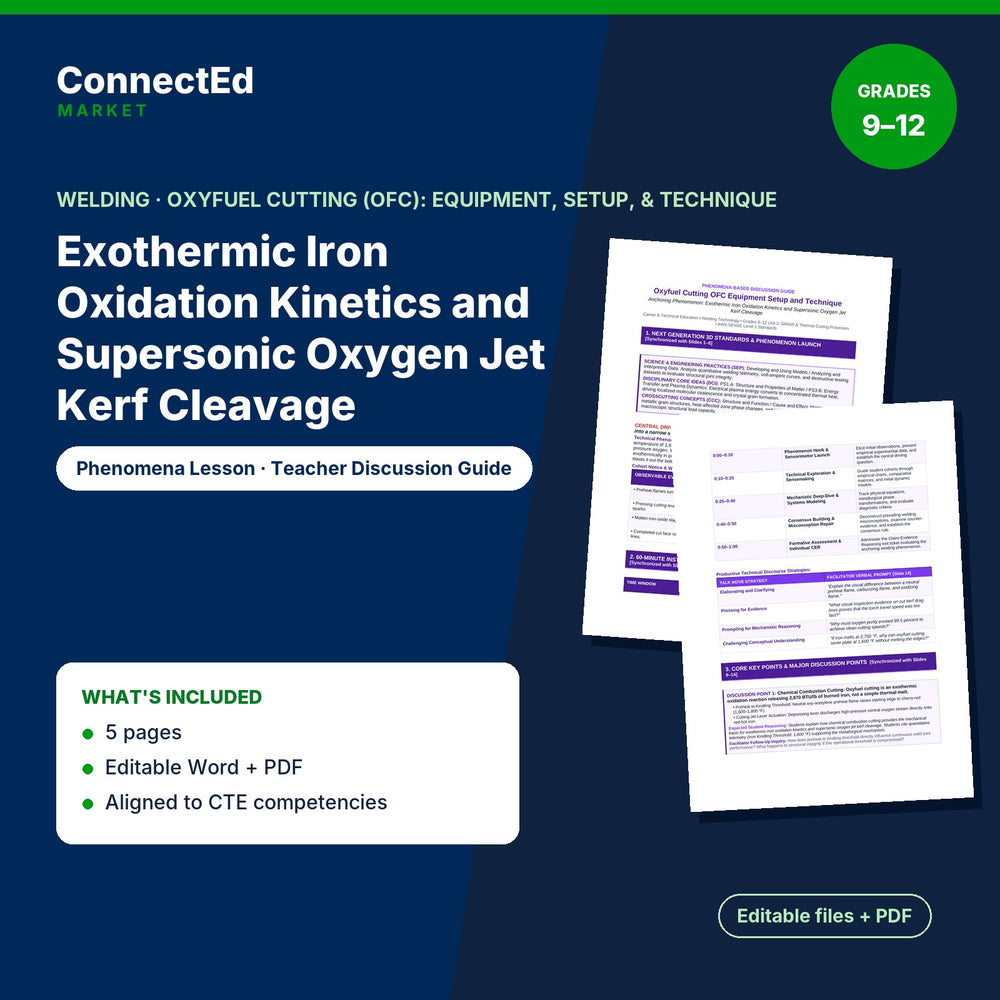
Oxyfuel Cutting (OFC): Equipment, Setup, & Technique Phenomena-Based Lesson: Exothermic Iron Oxidation Kinetics and Supersonic Oxygen Jet Kerf Cleavage Teacher Discussion Guide
$3.50
Microsoft Word (editable) + PDF (ready to print) · Instant download
This is the teacher discussion guide, with lesson flow, facilitation questions, anticipated student ideas and model explanations for leading the class discussion for the Phenomena-Based Lesson in the Welding (grades 9–12) chapter Oxyfuel Cutting (OFC): Equipment, Setup, & Technique, built around the phenomenon Exothermic Iron Oxidation Kinetics and Supersonic Oxygen Jet Kerf Cleavage. It is sold separately from the other two parts of the set.
Complete the set: Oxyfuel Cutting (OFC): Equipment, Setup, & Technique Phenomena-Based Lesson: Exothermic Iron Oxidation Kinetics and Supersonic Oxygen Jet Kerf Cleavage Presentation; Oxyfuel Cutting (OFC): Equipment, Setup, & Technique Phenomena-Based Lesson: Exothermic Iron Oxidation Kinetics and Supersonic Oxygen Jet Kerf Cleavage Student Response Sheet.
Sections: Phenomena-based Discussion Guide; Time Window; Instructional Phase; Facilitator & Student Actions; Talk Move Strategy; Claim; Evidence; Reasoning. Sample item: “CENTRAL DRIVING QUESTION: Why does a 6-inch thick slab of solid steel vanish into a narrow slot when blasted with cold oxygen gas once heated cherry red?”
What's inside: Teacher Discussion Guide (editable .docx + PDF, about 1,533 words, 5 pages).
Aligned Standards: Aligned to Career & Technical Education (CTE) program-of-study competencies for Manufacturing — welding and metal fabrication, with embedded academic literacy and career-readiness skills.
Format: Microsoft Word (editable) + PDF (ready to print)
Classroom use: Lead a 60-minute phenomenon-based lesson on the chapter with a timed discussion schedule. Use with the student response sheet and presentation.
Format note: If you do not open files with Microsoft Office, use the included PDF.