
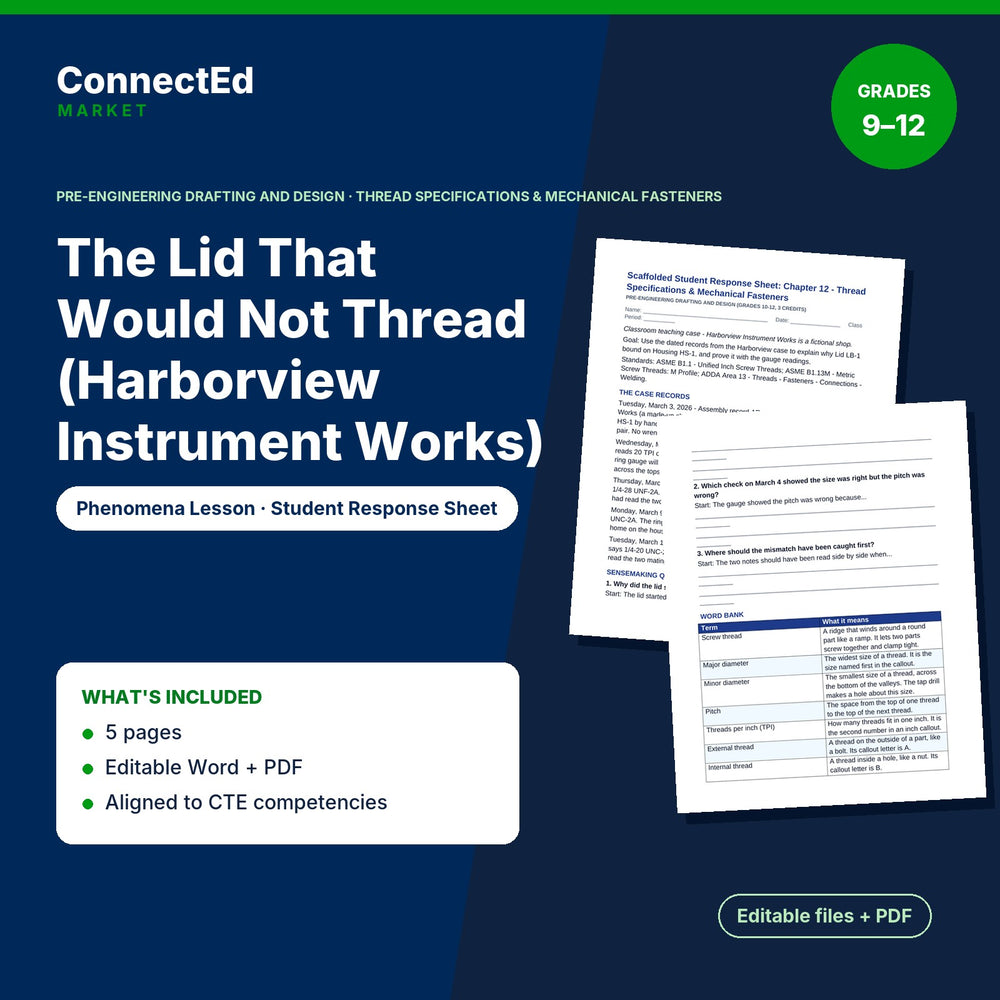
Thread Specifications & Mechanical Fasteners Scaffolded Phenomena-Based Lesson: The Lid That Would Not Thread (Harborview Instrument Works) Student Response Sheet
$3.50
Microsoft Word (editable) + PDF (ready to print) · Instant download
This is the student response sheet where students record observations, questions, evidence and their final claim–evidence–reasoning explanation for the Scaffolded Phenomena-Based Lesson in the Pre-Engineering Drafting and Design (grades 9–12) chapter Thread Specifications & Mechanical Fasteners, built around the phenomenon The Lid That Would Not Thread (Harborview Instrument Works). This scaffolded version adds sentence frames and extra supports for students who need them. It is sold separately from the other two parts of the set.
Complete the set: Thread Specifications & Mechanical Fasteners Scaffolded Phenomena-Based Lesson: The Lid That Would Not Thread (Harborview Instrument Works) Presentation; Thread Specifications & Mechanical Fasteners Scaffolded Phenomena-Based Lesson: The Lid That Would Not Thread (Harborview Instrument Works) Teacher Discussion Guide. Original version: Thread Specifications & Mechanical Fasteners Scaffolded Phenomena-Based Lesson: The Lid That Would Not Thread (Harborview Instrument Works) Student Response Sheet.
Sections: Standards Alignment; Learning Goals; The Case; Running The Discussion; Sensemaking Questions - Teacher Notes; Word Bank; CER Task And Key; Exit Ticket And Key. Sample item: “Q1. Why did the lid start to screw on, if its thread was wrong?”
What's inside: SCAFFOLDED Student Response Sheet (editable .docx + PDF, about 973 words, 5 pages).
Aligned Standards: Aligned to Career & Technical Education (CTE) program-of-study competencies for STEM — engineering and technology (drafting and design), with embedded academic literacy and career-readiness skills.
Format: Microsoft Word (editable) + PDF (ready to print)
Classroom use: Hand students this response sheet to record observations and answer investigation prompts as they explore the phenomenon. Use with the teacher discussion guide.
Format note: If you do not open files with Microsoft Office, use the included PDF.