
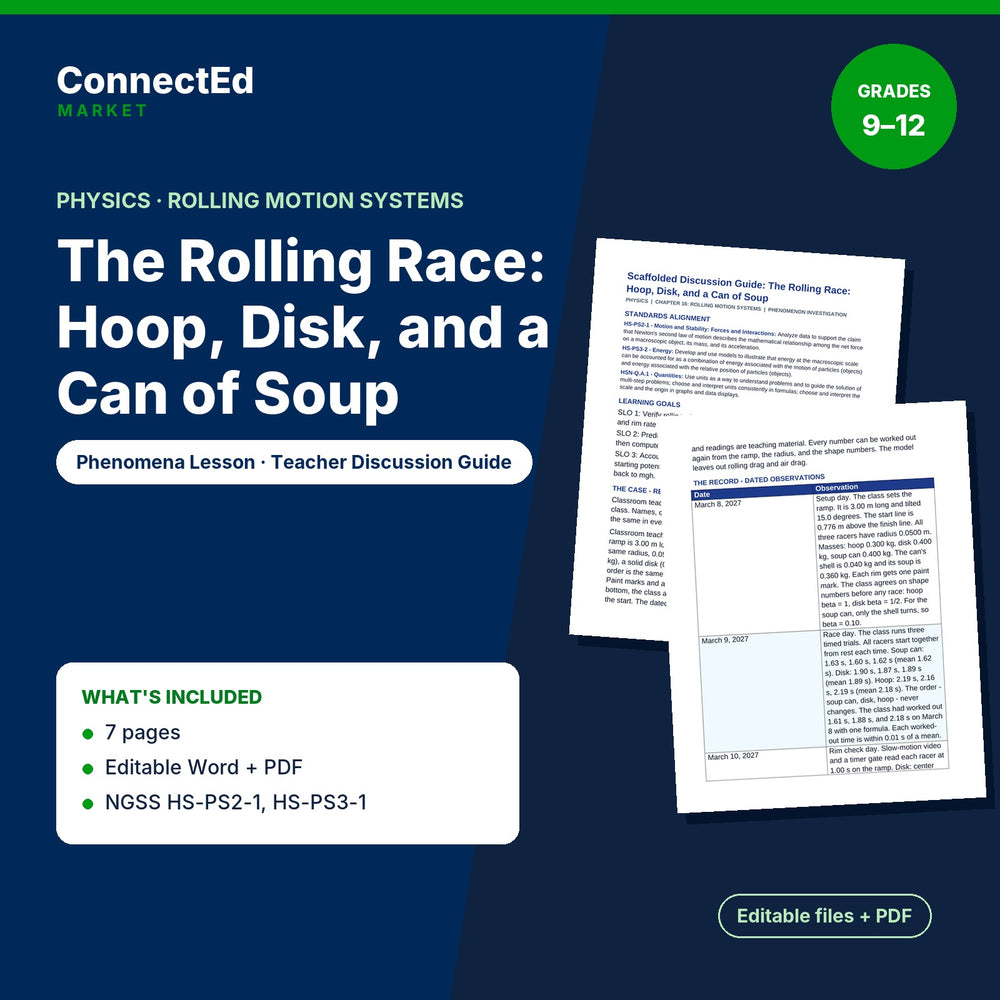
Rolling Motion Systems Scaffolded Phenomena-Based Lesson: The Rolling Race: Hoop, Disk, and a Can of Soup Teacher Discussion Guide
$3.50
Microsoft Word (editable) + PDF (ready to print) · Instant download
This is the teacher discussion guide, with lesson flow, facilitation questions, anticipated student ideas and model explanations for leading the class discussion for the Scaffolded Phenomena-Based Lesson in the high school Physics (grades 9–12) chapter Rolling Motion Systems, built around the phenomenon The Rolling Race: Hoop, Disk, and a Can of Soup. This scaffolded version adds sentence frames and extra supports for students who need them. It is sold separately from the other two parts of the set.
Complete the set: Rolling Motion Systems Scaffolded Phenomena-Based Lesson: The Rolling Race: Hoop, Disk, and a Can of Soup Presentation; Rolling Motion Systems Scaffolded Phenomena-Based Lesson: The Rolling Race: Hoop, Disk, and a Can of Soup Student Response Sheet. Original version: Rolling Motion Systems Phenomena-Based Lesson: The Rolling Race: Hoop, Disk, and a Can of Soup Teacher Discussion Guide.
Sections: Standards Alignment; Learning Goals; The Case - Read First; The Record - Dated Observations; How To Run The Talk; Talk Moves For The Teacher; The Record; Word Bank. Sample item: “1. The soup can and the disk have the same mass, 0.400 kg, and the same radius. What is unlike about them? Which March 8, 2027 note says it, before any race?”
What's inside: SCAFFOLDED Teacher Discussion Guide (editable .docx + PDF, about 1,967 words, 7 pages).
Aligned Standards: HS-PS2-1 — Analyze data to support the claim that Newton’s second law of motion describes the mathematical relationship among the net force on a macroscopic object, its mass, and its acceleration. HS-PS3-1 — Create a computational model to calculate the change in the energy of one component in a system when the change in energy of the other component(s) and energy flows in and out of the system are known.
Format: Microsoft Word (editable) + PDF (ready to print)
Classroom use: Lead a 60-minute phenomenon-based lesson on Rolling Motion Systems with a timed discussion schedule. Use with the student response sheet and presentation.
Format note: If you do not open files with Microsoft Office, use the included PDF.