
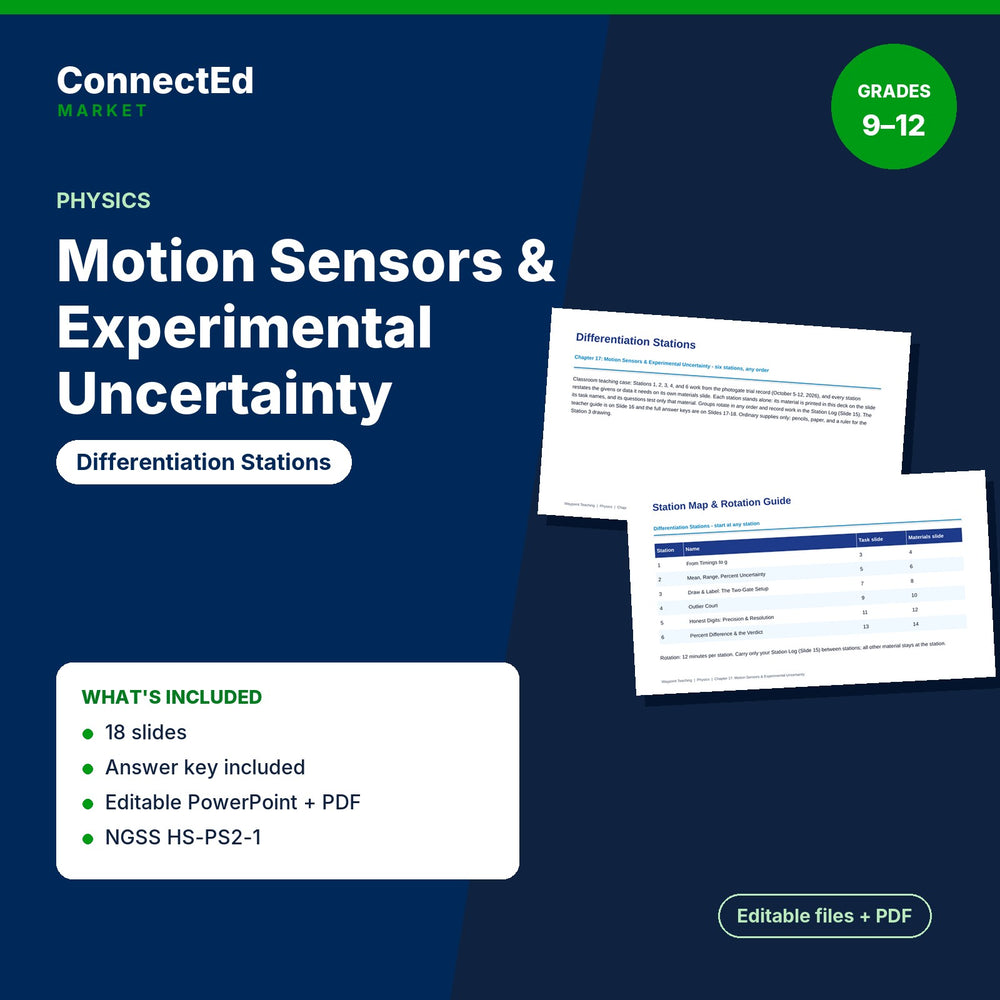
Motion Sensors & Experimental Uncertainty Differentiation Stations
$3.50
Microsoft PowerPoint (editable) + PDF (ready to print) · Instant download
Motion Sensors & Experimental Uncertainty Differentiation Stations is a full set of differentiation stations for high school Physics (grades 9–12) on Motion Sensors & Experimental Uncertainty.
Pairs with: Motion Sensors & Experimental Uncertainty Slide Show Presentation; Motion Sensors & Experimental Uncertainty Guided Notes; Motion Sensors & Experimental Uncertainty Lesson Quiz; Motion Sensors & Experimental Uncertainty Unit Test.
Sample item: “Q3. Card C uses a 0.0250 m flag. What changes in your first step, and what stays the same?”
What's inside: Differentiation Stations (editable .pptx + PDF, 18 slides); answer key / model answers for the teacher.
Aligned Standards: HS-PS2-1 — Analyze data to support the claim that Newton’s second law of motion describes the mathematical relationship among the net force on a macroscopic object, its mass, and its acceleration.
Format: Microsoft PowerPoint (editable) + PDF (ready to print)
Classroom use: Set up stations so students work through Motion Sensors & Experimental Uncertainty in rotations, from vocabulary matching to reading and analysis. Each station is its own activity, so you can rotate groups or assign stations individually.
Format note: If you do not open files with Microsoft Office, use the included PDF.