
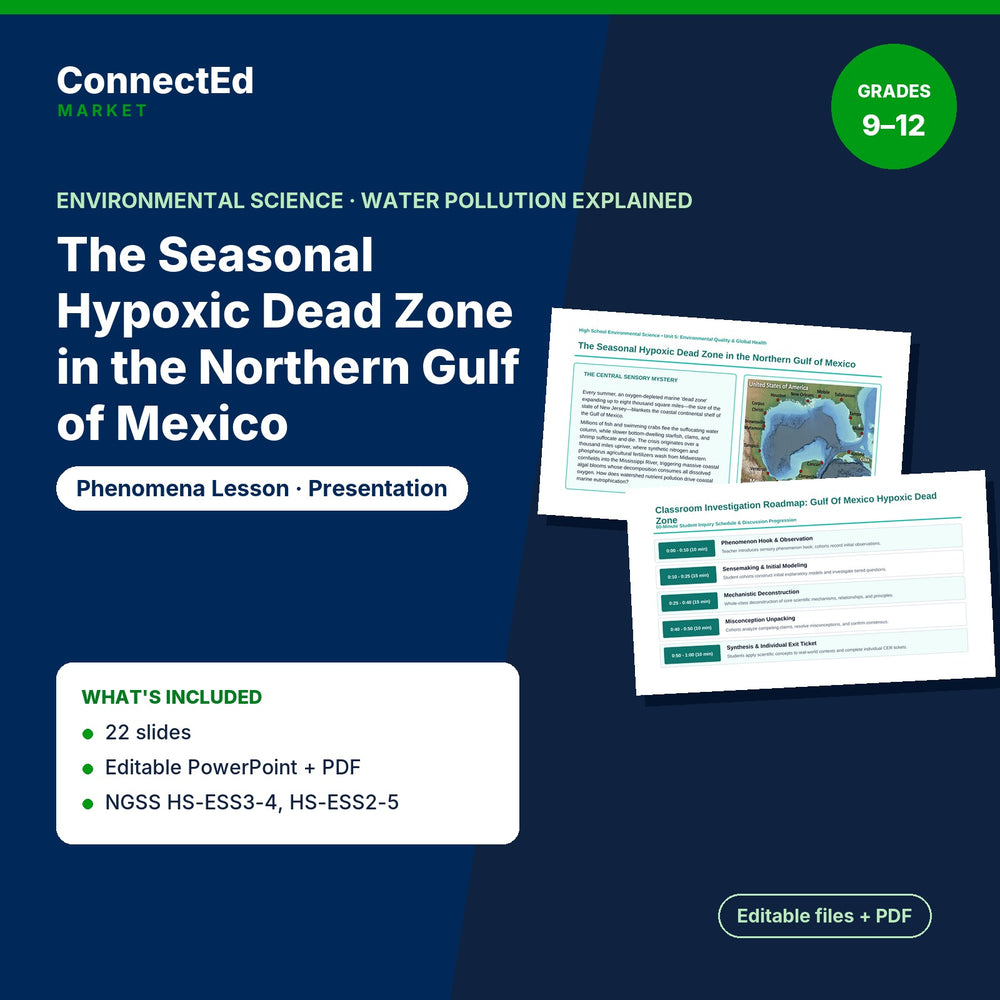
Water Pollution Explained Phenomena-Based Lesson: The Seasonal Hypoxic Dead Zone in the Northern Gulf of Mexico Presentation
$3.50
Microsoft PowerPoint (editable) + PDF (ready to print) · Instant download
This is the student-facing slide presentation that introduces the phenomenon, walks the class through observations and driving questions, and frames the evidence students will use for the Phenomena-Based Lesson in the high school Environmental Science (grades 9–12) chapter Water Pollution Explained, built around the phenomenon The Seasonal Hypoxic Dead Zone in the Northern Gulf of Mexico. It is sold separately from the other two parts of the set.
Complete the set: Water Pollution Explained Phenomena-Based Lesson: The Seasonal Hypoxic Dead Zone in the Northern Gulf of Mexico Teacher Discussion Guide; Water Pollution Explained Phenomena-Based Lesson: The Seasonal Hypoxic Dead Zone in the Northern Gulf of Mexico Student Response Sheet. Scaffolded version: Water Pollution Explained Scaffolded Phenomena-Based Lesson: The Seasonal Hypoxic Dead Zone in the Northern Gulf of Mexico Presentation.
Sections: Section 1: Three-dimensional Learning Alignment (ngss); NGSS Dimension; Aligned Three-dimensional Learning Goal; Section 2: Anchoring Phenomenon & Driving Inquiry; Section 3: Productive Science Talk Moves Matrix; Talk Move Category; Verbatim Facilitation Prompt & Goal; Section 5: Student Misconceptions & Scientific Corrections. Sample item: “How does watershed nutrient pollution drive coastal marine eutrophication?”
What's inside: Student Slide Show (editable .pptx + PDF, 22 slides).
Aligned Standards: HS-ESS3-4 — Evaluate or refine a technological solution that reduces impacts of human activities on natural systems. HS-ESS2-5 — Plan and conduct an investigation of the properties of water and its effects on Earth materials and surface processes.
Format: Microsoft PowerPoint (editable) + PDF (ready to print)
Classroom use: Project this presentation to introduce the phenomenon and guide the investigation, then move into discussion with the teacher guide.
Format note: If you do not open files with Microsoft Office, use the included PDF.