
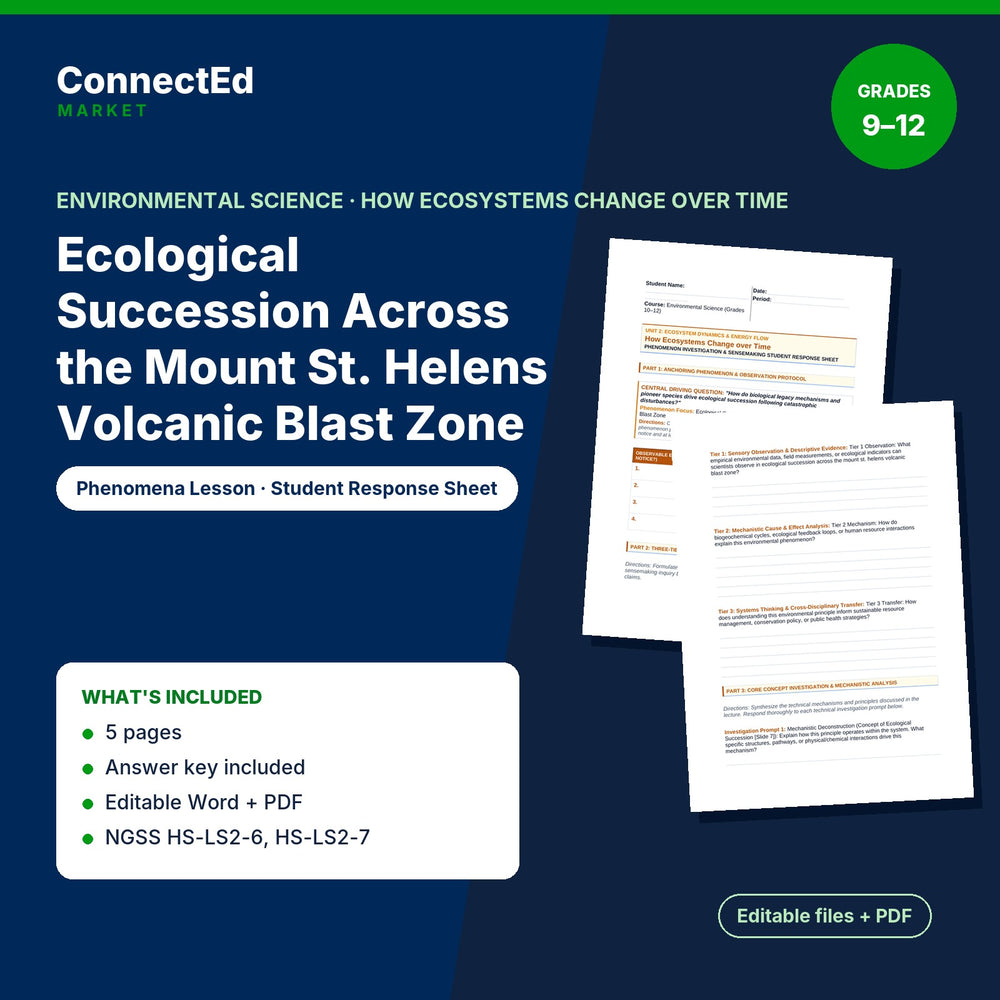
How Ecosystems Change Over Time Phenomena-Based Lesson: Ecological Succession Across the Mount St. Helens Volcanic Blast Zone Student Response Sheet
$3.50
Microsoft Word (editable) + PDF (ready to print) · Instant download
This is the student response sheet where students record observations, questions, evidence and their final claim–evidence–reasoning explanation for the Phenomena-Based Lesson in the high school Environmental Science (grades 9–12) chapter How Ecosystems Change Over Time, built around the phenomenon Ecological Succession Across the Mount St. Helens Volcanic Blast Zone. It is sold separately from the other two parts of the set.
Complete the set: How Ecosystems Change Over Time Phenomena-Based Lesson: Ecological Succession Across the Mount St. Helens Volcanic Blast Zone Presentation; How Ecosystems Change Over Time Phenomena-Based Lesson: Ecological Succession Across the Mount St. Helens Volcanic Blast Zone Teacher Discussion Guide. Scaffolded version: How Ecosystems Change Over Time Scaffolded Phenomena-Based Lesson: Ecological Succession Across the Mount St. Helens Volcanic Blast Zone Student Response Sheet.
Sections: Section 1: Three-dimensional Learning Alignment (ngss); NGSS Dimension; Aligned Three-dimensional Learning Goal; Section 2: Anchoring Phenomenon & Driving Inquiry; Section 3: Productive Science Talk Moves Matrix; Talk Move Category; Verbatim Facilitation Prompt & Goal; Section 5: Student Misconceptions & Scientific Corrections. Sample item: “How do primary and secondary ecological succession rebuild living ecosystems after catastrophic disturbances?”
What's inside: Student Response Sheet (editable .docx + PDF, about 615 words, 5 pages); answer key / model answers for the teacher.
Aligned Standards: HS-LS2-6 — Evaluate claims, evidence, and reasoning that the complex interactions in ecosystems maintain relatively consistent numbers and types of organisms in stable conditions, but changing conditions may result in a new ecosystem. HS-LS2-7 — Design, evaluate, and refine a solution for reducing the impacts of human activities on the environment and biodiversity.
Format: Microsoft Word (editable) + PDF (ready to print)
Classroom use: Hand students this response sheet to record observations and answer investigation prompts as they explore the phenomenon. Use with the teacher discussion guide.
Format note: If you do not open files with Microsoft Office, use the included PDF.