
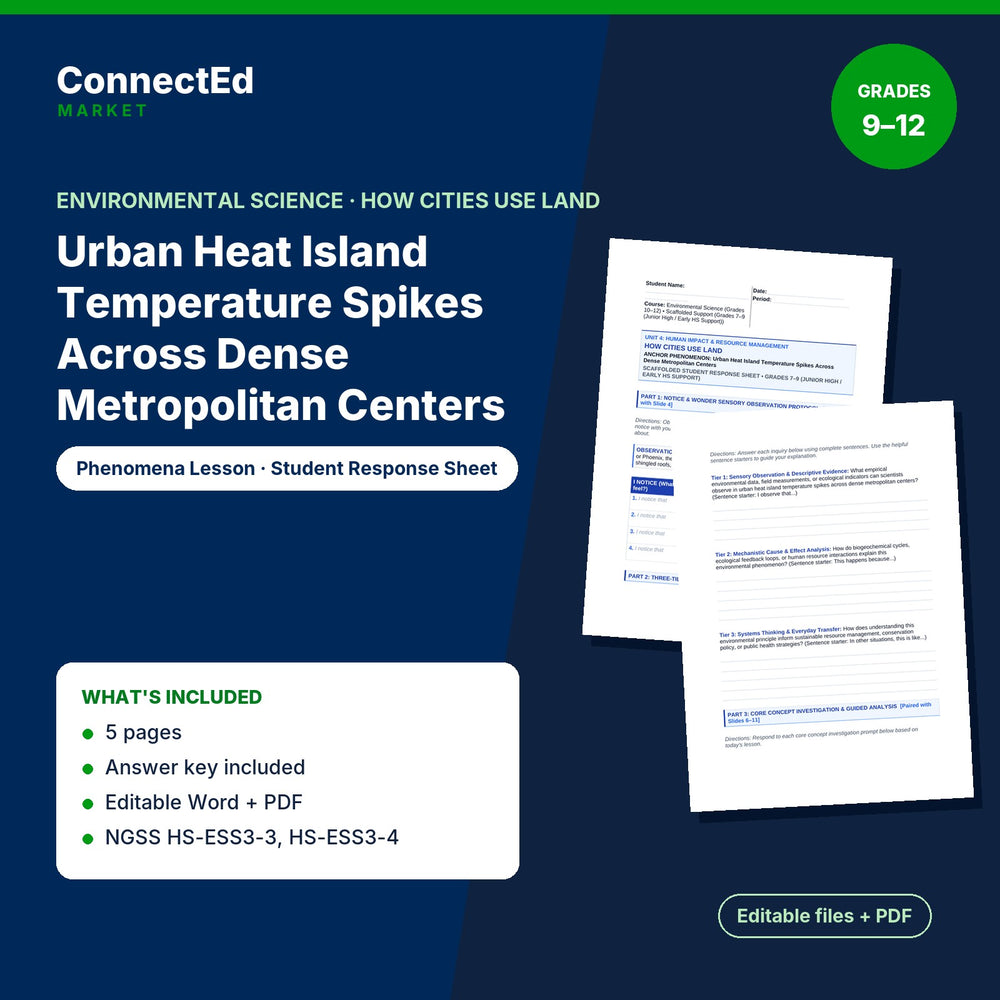
How Cities Use Land Scaffolded Phenomena-Based Lesson: Urban Heat Island Temperature Spikes Across Dense Metropolitan Centers Student Response Sheet
Free
Microsoft Word (editable) + PDF (ready to print) · Instant download
This is the student response sheet where students record observations, questions, evidence and their final claim–evidence–reasoning explanation for the Scaffolded Phenomena-Based Lesson in the high school Environmental Science (grades 9–12) chapter How Cities Use Land, built around the phenomenon Urban Heat Island Temperature Spikes Across Dense Metropolitan Centers. This scaffolded version adds sentence frames and extra supports for students who need them. It is sold separately from the other two parts of the set.
Complete the set: How Cities Use Land Scaffolded Phenomena-Based Lesson: Urban Heat Island Temperature Spikes Across Dense Metropolitan Centers Presentation; How Cities Use Land Scaffolded Phenomena-Based Lesson: Urban Heat Island Temperature Spikes Across Dense Metropolitan Centers Teacher Discussion Guide. Original version: How Cities Use Land Phenomena-Based Lesson: Urban Heat Island Temperature Spikes Across Dense Metropolitan Centers Student Response Sheet.
Sections: Section 1: Three-dimensional Learning Alignment (ngss); NGSS Dimension; Scaffolded Three-dimensional Learning Goal; Section 3: Scaffolded Science Talk Moves Matrix; Scaffolded Talk Move; Verbatim Facilitation Prompt & Talk Goal; Everyday Student Misconception (flawed Claim); Scientific Evidence & Intuitive Correction. Sample item: “On a scorching midsummer afternoon in downtown Atlanta or Phoenix, thermal infrared satellite imaging reveals that asphalt streets, dark shingled roofs, and concrete parking lots heat up to over 65 de”
What's inside: SCAFFOLDED Student Response Sheet (editable .docx + PDF, about 716 words, 5 pages); answer key / model answers for the teacher.
Aligned Standards: HS-ESS3-3 — Create a computational simulation to illustrate the relationships among management of natural resources, the sustainability of human populations, and biodiversity. HS-ESS3-4 — Evaluate or refine a technological solution that reduces impacts of human activities on natural systems.
Format: Microsoft Word (editable) + PDF (ready to print)
Classroom use: Hand students this response sheet to record observations and answer investigation prompts as they explore the phenomenon. Use with the teacher discussion guide.
Format note: If you do not open files with Microsoft Office, use the included PDF.