
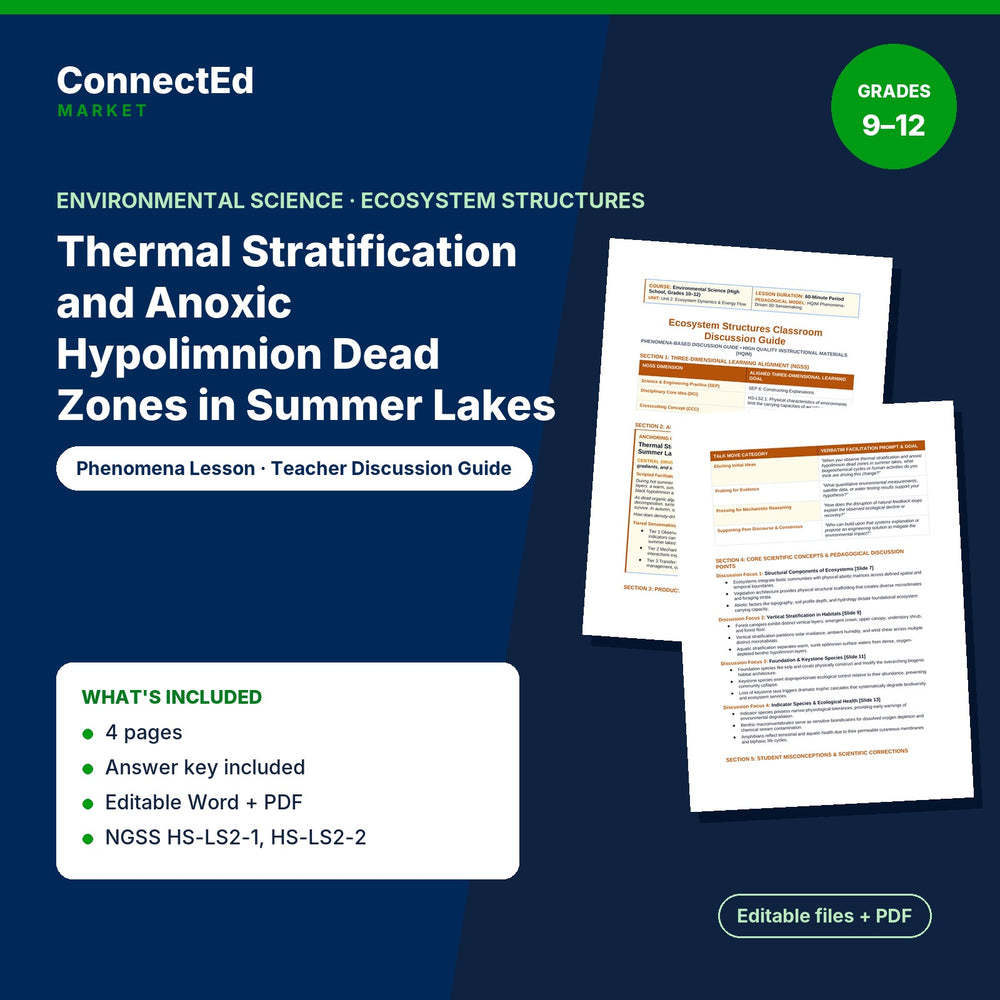
Ecosystem Structures Phenomena-Based Lesson: Thermal Stratification and Anoxic Hypolimnion Dead Zones in Summer Lakes Teacher Discussion Guide
$3.50
Microsoft Word (editable) + PDF (ready to print) · Instant download
This is the teacher discussion guide, with lesson flow, facilitation questions, anticipated student ideas and model explanations for leading the class discussion for the Phenomena-Based Lesson in the high school Environmental Science (grades 9–12) chapter Ecosystem Structures, built around the phenomenon Thermal Stratification and Anoxic Hypolimnion Dead Zones in Summer Lakes. It is sold separately from the other two parts of the set.
Complete the set: Ecosystem Structures Phenomena-Based Lesson: Thermal Stratification and Anoxic Hypolimnion Dead Zones in Summer Lakes Presentation; Ecosystem Structures Phenomena-Based Lesson: Thermal Stratification and Anoxic Hypolimnion Dead Zones in Summer Lakes Student Response Sheet. Scaffolded version: Ecosystem Structures Scaffolded Phenomena-Based Lesson: Thermal Stratification and Anoxic Hypolimnion Dead Zones in Summer Lakes Teacher Discussion Guide.
Sections: Section 1: Three-dimensional Learning Alignment (ngss); NGSS Dimension; Aligned Three-dimensional Learning Goal; Section 2: Anchoring Phenomenon & Driving Inquiry; Section 3: Productive Science Talk Moves Matrix; Talk Move Category; Verbatim Facilitation Prompt & Goal; Section 5: Student Misconceptions & Scientific Corrections. Sample item: “How does density-driven physical stratification govern aquatic ecosystem chemistry?”
What's inside: Teacher Discussion Guide (editable .docx + PDF, about 1,016 words, 4 pages); answer key / model answers for the teacher.
Aligned Standards: HS-LS2-1 — Use mathematical and/or computational representations to support explanations of factors that affect carrying capacity of ecosystems at different scales. HS-LS2-2 — Use mathematical representations to support and revise explanations based on evidence about factors affecting biodiversity and populations in ecosystems of different scales.
Format: Microsoft Word (editable) + PDF (ready to print)
Classroom use: Lead a 60-minute phenomenon-based lesson on Ecosystem Structures with a timed discussion schedule. Use with the student response sheet and presentation.
Format note: If you do not open files with Microsoft Office, use the included PDF.