
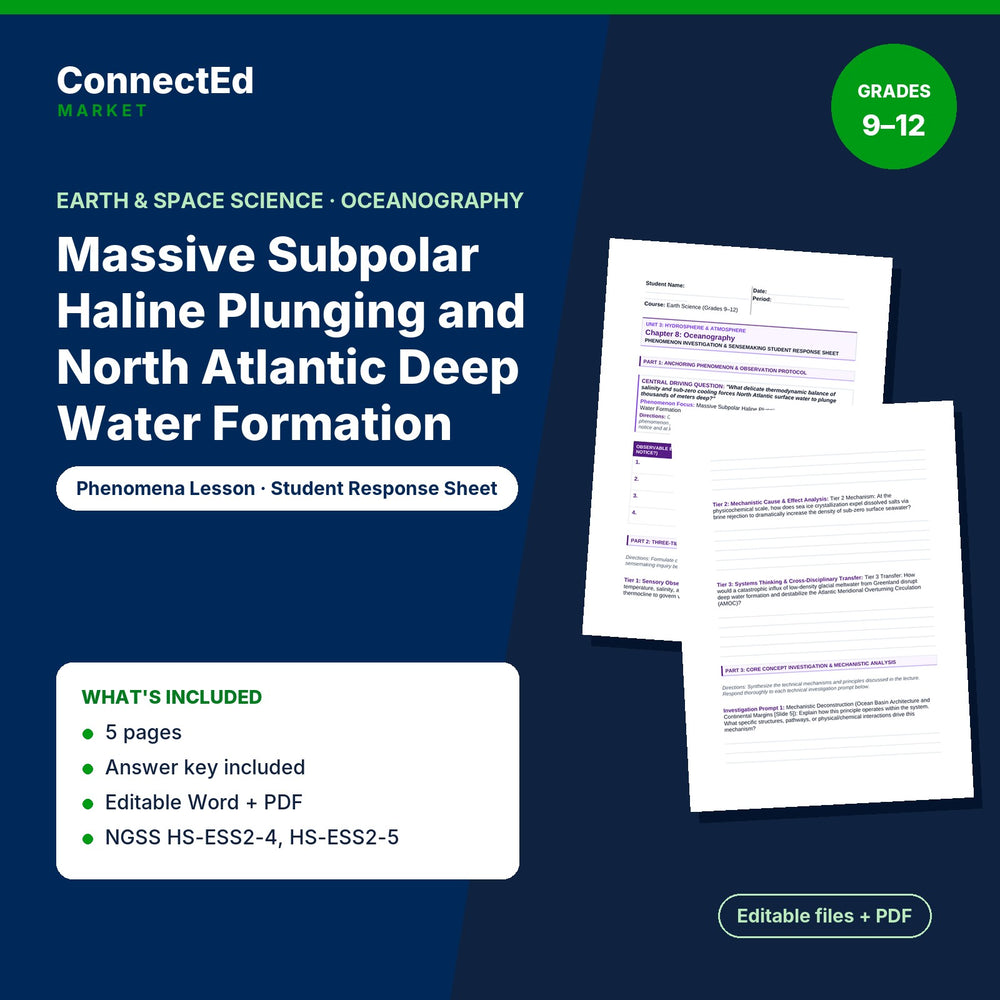
Oceanography Phenomena-Based Lesson: Massive Subpolar Haline Plunging and North Atlantic Deep Water Formation Student Response Sheet
$3.50
Microsoft Word (editable) + PDF (ready to print) · Instant download
This is the student response sheet where students record observations, questions, evidence and their final claim–evidence–reasoning explanation for the Phenomena-Based Lesson in the high school Earth & Space Science (grades 9–12) chapter Oceanography, built around the phenomenon Massive Subpolar Haline Plunging and North Atlantic Deep Water Formation. It is sold separately from the other two parts of the set.
Complete the set: Oceanography Phenomena-Based Lesson: Massive Subpolar Haline Plunging and North Atlantic Deep Water Formation Presentation; Oceanography Phenomena-Based Lesson: Massive Subpolar Haline Plunging and North Atlantic Deep Water Formation Teacher Discussion Guide. Scaffolded version: Oceanography Scaffolded Phenomena-Based Lesson: Massive Subpolar Haline Plunging and North Atlantic Deep Water Formation Student Response Sheet.
Sections: NGSS Dimension; Specific Performance Expectation & Dimensional Alignment; Slides; Segment; Focus Activity & Instructional Goal; Anchoring Driving Question (student Sensemaking):; Talk Move Category; Teacher Facilitation Prompt & Sensemaking Strategy. Sample item: “What delicate thermodynamic balance of salinity, polar cooling, and brine rejection forces buoyant surface water to become dense enough to sink to the ocean floor?”
What's inside: Student Response Sheet (editable .docx + PDF, about 631 words, 5 pages); answer key / model answers for the teacher.
Aligned Standards: HS-ESS2-4 — Use a model to describe how variations in the flow of energy into and out of Earth’s systems result in changes in climate. HS-ESS2-5 — Plan and conduct an investigation of the properties of water and its effects on Earth materials and surface processes.
Format: Microsoft Word (editable) + PDF (ready to print)
Classroom use: Hand students this response sheet to record observations and answer investigation prompts as they explore the phenomenon. Use with the teacher discussion guide.
Format note: If you do not open files with Microsoft Office, use the included PDF.