
Melting Points in the Kitchen: Table Salt vs. Table Sugar Reading Worksheet
Free
Microsoft Word (editable) + PDF (ready to print) · Instant download
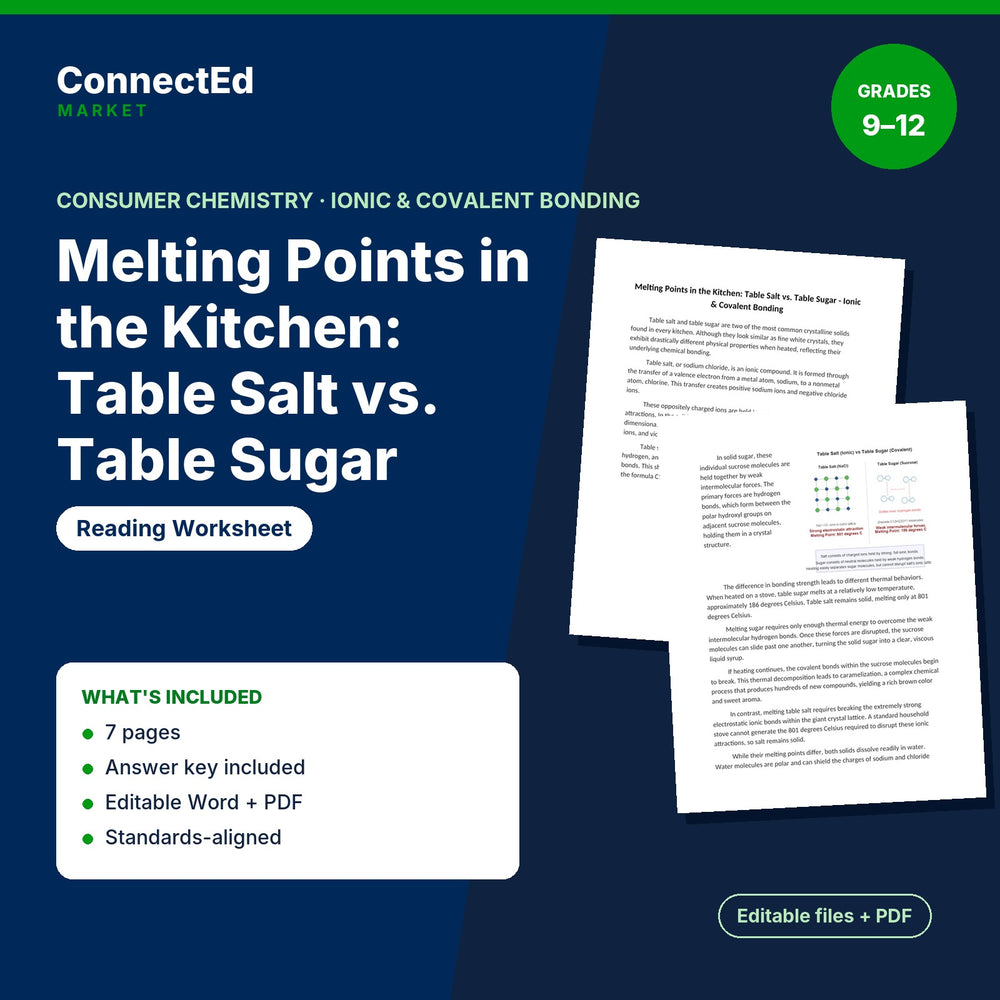
Melting Points in the Kitchen: Table Salt vs. Table Sugar Reading Worksheet is a reading passage with comprehension questions for Consumer Chemistry (grades 9–12) on Melting Points in the Kitchen: Table Salt vs. Table Sugar (chapter: Ionic & Covalent Bonding).
Pairs with: Ionic & Covalent Bonding Slide Show Presentation; Ionic & Covalent Bonding Guided Notes; Ionic & Covalent Bonding Lesson Quiz; Ionic & Covalent Bonding Unit Test.
Sample item: “4. How do carbon, hydrogen, and oxygen atoms bind to form a sucrose molecule?”
What's inside: Melting Points in the Kitchen: Table Salt vs. Table Sugar - Ionic & Covalent Bonding (editable .docx + PDF, about 926 words, 7 pages); answer key / model answers for the teacher.
Aligned Standards: NGSS High School Physical Science (HS-PS) disciplinary core ideas and the science practices of analyzing data and constructing explanations.
Format: Microsoft Word (editable) + PDF (ready to print)
Classroom use: Assign the reading passage on the chapter with comprehension questions for independent work, a sub day, or a literacy block. The answer key is included.
Format note: If you do not open files with Microsoft Office, use the included PDF.