
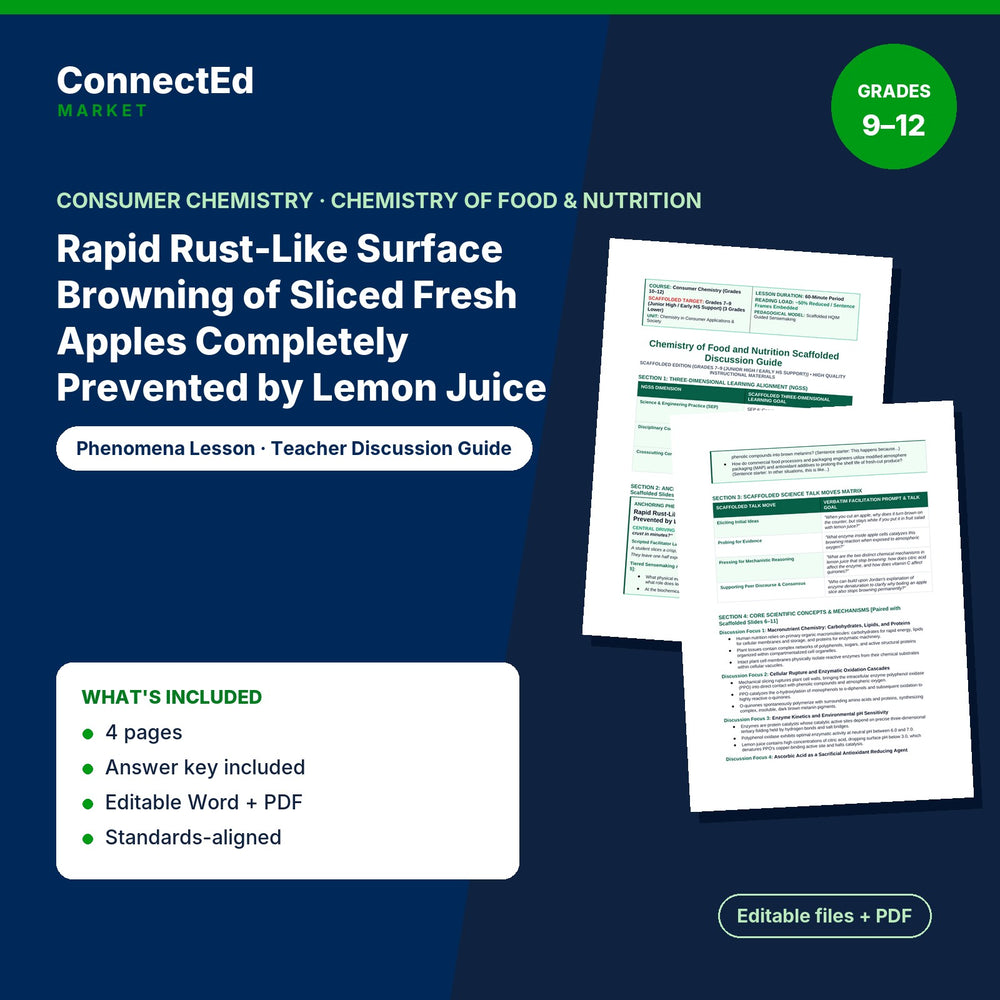
Chemistry of Food & Nutrition Scaffolded Phenomena-Based Lesson: Rapid Rust-Like Surface Browning of Sliced Fresh Apples Completely Prevented by Lemon Juice Teacher Discussion Guide
Free
Microsoft Word (editable) + PDF (ready to print) · Instant download
This is the teacher discussion guide, with lesson flow, facilitation questions, anticipated student ideas and model explanations for leading the class discussion for the Scaffolded Phenomena-Based Lesson in the Consumer Chemistry (grades 9–12) chapter Chemistry of Food & Nutrition, built around the phenomenon Rapid Rust-Like Surface Browning of Sliced Fresh Apples Completely Prevented by Lemon Juice. This scaffolded version adds sentence frames and extra supports for students who need them. It is sold separately from the other two parts of the set.
Complete the set: Chemistry of Food & Nutrition Scaffolded Phenomena-Based Lesson: Rapid Rust-Like Surface Browning of Sliced Fresh Apples Completely Prevented by Lemon Juice Presentation; Chemistry of Food & Nutrition Scaffolded Phenomena-Based Lesson: Rapid Rust-Like Surface Browning of Sliced Fresh Apples Completely Prevented by Lemon Juice Student Response Sheet. Original version: Chemistry of Food & Nutrition Phenomena-Based Lesson: Rapid Rust-Like Surface Browning of Sliced Fresh Apples Completely Prevented by Lemon Juice Teacher Discussion Guide.
Sections: Section 1: Three-dimensional Learning Alignment (ngss); NGSS Dimension; Scaffolded Three-dimensional Learning Goal; Section 3: Scaffolded Science Talk Moves Matrix; Scaffolded Talk Move; Verbatim Facilitation Prompt & Talk Goal; Everyday Student Misconception (flawed Claim); Scientific Evidence & Intuitive Correction. Sample item: “They leave one half exposed on the kitchen cutting board?”
What's inside: SCAFFOLDED Teacher Discussion Guide (editable .docx + PDF, about 1,279 words, 4 pages); answer key / model answers for the teacher.
Aligned Standards: NGSS High School Physical Science (HS-PS) disciplinary core ideas and the science practices of analyzing data and constructing explanations.
Format: Microsoft Word (editable) + PDF (ready to print)
Classroom use: Lead a 60-minute phenomenon-based lesson on Chemistry of Food & Nutrition with a timed discussion schedule. Use with the student response sheet and presentation.
Format note: If you do not open files with Microsoft Office, use the included PDF.