
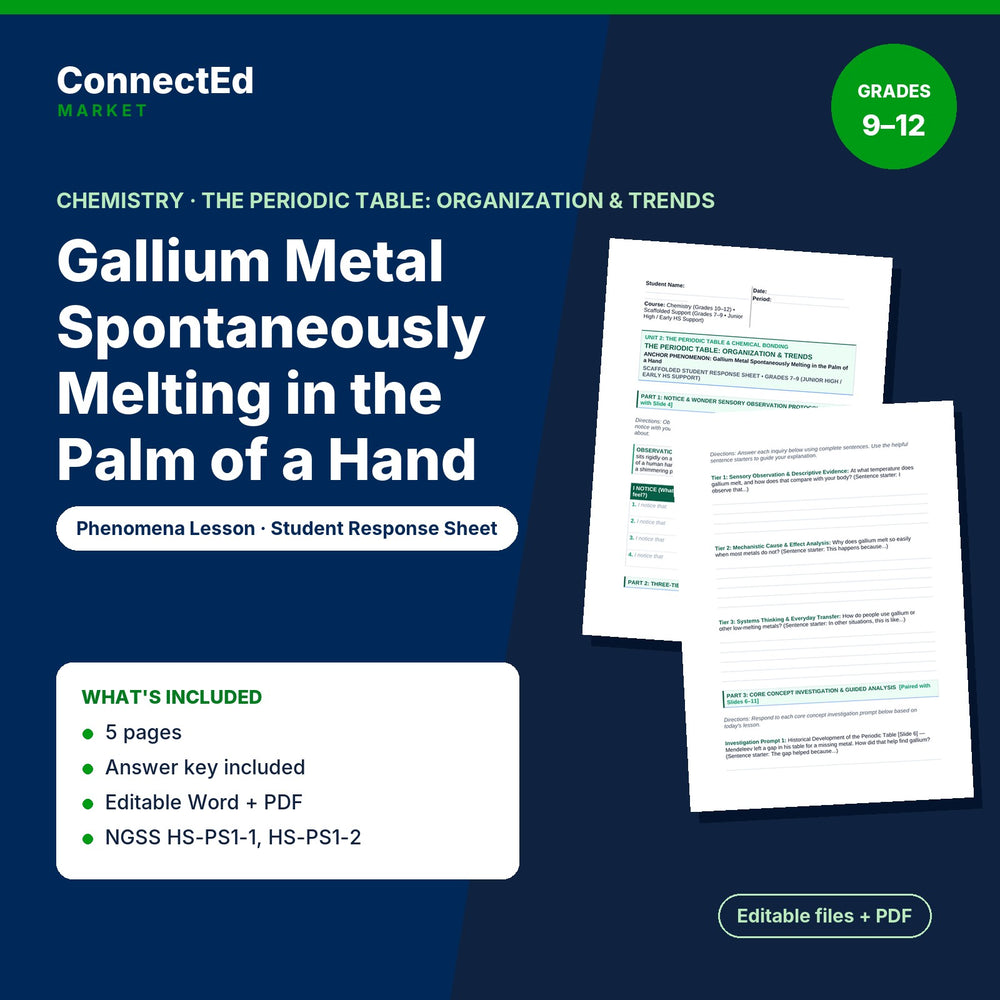
The Periodic Table: Organization & Trends Scaffolded Phenomena-Based Lesson: Gallium Metal Spontaneously Melting in the Palm of a Hand Student Response Sheet
$3.50
Microsoft Word (editable) + PDF (ready to print) · Instant download
This is the student response sheet where students record observations, questions, evidence and their final claim–evidence–reasoning explanation for the Scaffolded Phenomena-Based Lesson in the high school Chemistry (grades 9–12) chapter The Periodic Table: Organization & Trends, built around the phenomenon Gallium Metal Spontaneously Melting in the Palm of a Hand. This scaffolded version adds sentence frames and extra supports for students who need them. It is sold separately from the other two parts of the set.
Complete the set: The Periodic Table: Organization & Trends Scaffolded Phenomena-Based Lesson: Gallium Metal Spontaneously Melting in the Palm of a Hand Presentation; The Periodic Table: Organization & Trends Scaffolded Phenomena-Based Lesson: Gallium Metal Spontaneously Melting in the Palm of a Hand Teacher Discussion Guide. Original version: The Periodic Table: Organization & Trends Phenomena-Based Lesson: Gallium Metal Spontaneously Melting in the Palm of a Hand Student Response Sheet.
Sections: Section 1: Three-dimensional Learning Alignment (ngss); NGSS Dimension; Scaffolded Three-dimensional Learning Goal; Section 3: Scaffolded Science Talk Moves Matrix; Scaffolded Talk Move; Verbatim Facilitation Prompt & Talk Goal; Everyday Student Misconception (flawed Claim); Scientific Evidence & Intuitive Correction. Sample item: “Gallium melts in a hand because its melting point is ____________ body temperature.”
What's inside: SCAFFOLDED Student Response Sheet (editable .docx + PDF, about 715 words, 5 pages); answer key / model answers for the teacher.
Aligned Standards: HS-PS1-1 — Use the periodic table as a model to predict the relative properties of elements based on the patterns of electrons in the outermost energy level of atoms. HS-PS1-2 — Construct and revise an explanation for the outcome of a simple chemical reaction based on the outermost electron states of atoms, trends in the periodic table, and knowledge of the patterns of chemical properties.
Format: Microsoft Word (editable) + PDF (ready to print)
Classroom use: Hand students this response sheet to record observations and answer investigation prompts as they explore the phenomenon. Use with the teacher discussion guide.
Format note: If you do not open files with Microsoft Office, use the included PDF.