
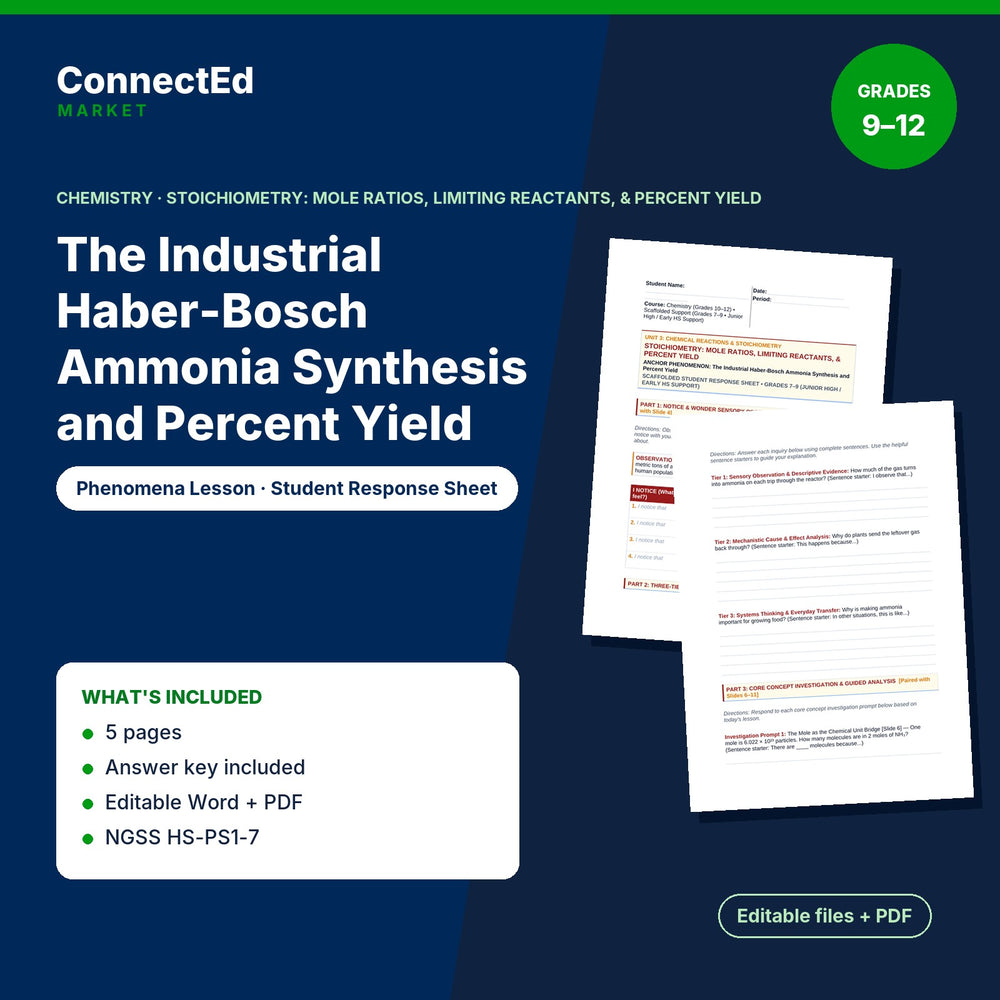
Stoichiometry: Mole Ratios, Limiting Reactants, & Percent Yield Scaffolded Phenomena-Based Lesson: The Industrial Haber-Bosch Ammonia Synthesis and Percent Yield Student Response Sheet
$3.50
Microsoft Word (editable) + PDF (ready to print) · Instant download
This is the student response sheet where students record observations, questions, evidence and their final claim–evidence–reasoning explanation for the Scaffolded Phenomena-Based Lesson in the high school Chemistry (grades 9–12) chapter Stoichiometry: Mole Ratios, Limiting Reactants, & Percent Yield, built around the phenomenon The Industrial Haber-Bosch Ammonia Synthesis and Percent Yield. This scaffolded version adds sentence frames and extra supports for students who need them. It is sold separately from the other two parts of the set.
Complete the set: Stoichiometry: Mole Ratios, Limiting Reactants, & Percent Yield Scaffolded Phenomena-Based Lesson: The Industrial Haber-Bosch Ammonia Synthesis and Percent Yield Presentation; Stoichiometry: Mole Ratios, Limiting Reactants, & Percent Yield Scaffolded Phenomena-Based Lesson: The Industrial Haber-Bosch Ammonia Synthesis and Percent Yield Teacher Discussion Guide. Original version: Stoichiometry: Mole Ratios, Limiting Reactants, & Percent Yield Phenomena-Based Lesson: The Industrial Haber-Bosch Ammonia Synthesis and Percent Yield Student Response Sheet.
Sections: Section 1: Three-dimensional Learning Alignment (ngss); NGSS Dimension; Scaffolded Three-dimensional Learning Goal; Section 3: Scaffolded Science Talk Moves Matrix; Scaffolded Talk Move; Verbatim Facilitation Prompt & Talk Goal; Everyday Student Misconception (flawed Claim); Scientific Evidence & Intuitive Correction. Sample item: “The mole ratio of N₂ to H₂ is ____________.”
What's inside: SCAFFOLDED Student Response Sheet (editable .docx + PDF, about 690 words, 5 pages); answer key / model answers for the teacher.
Aligned Standards: HS-PS1-7 — Use mathematical representations to support the claim that atoms, and therefore mass, are conserved during a chemical reaction.
Format: Microsoft Word (editable) + PDF (ready to print)
Classroom use: Hand students this response sheet to record observations and answer investigation prompts as they explore the phenomenon. Use with the teacher discussion guide.
Format note: If you do not open files with Microsoft Office, use the included PDF.