
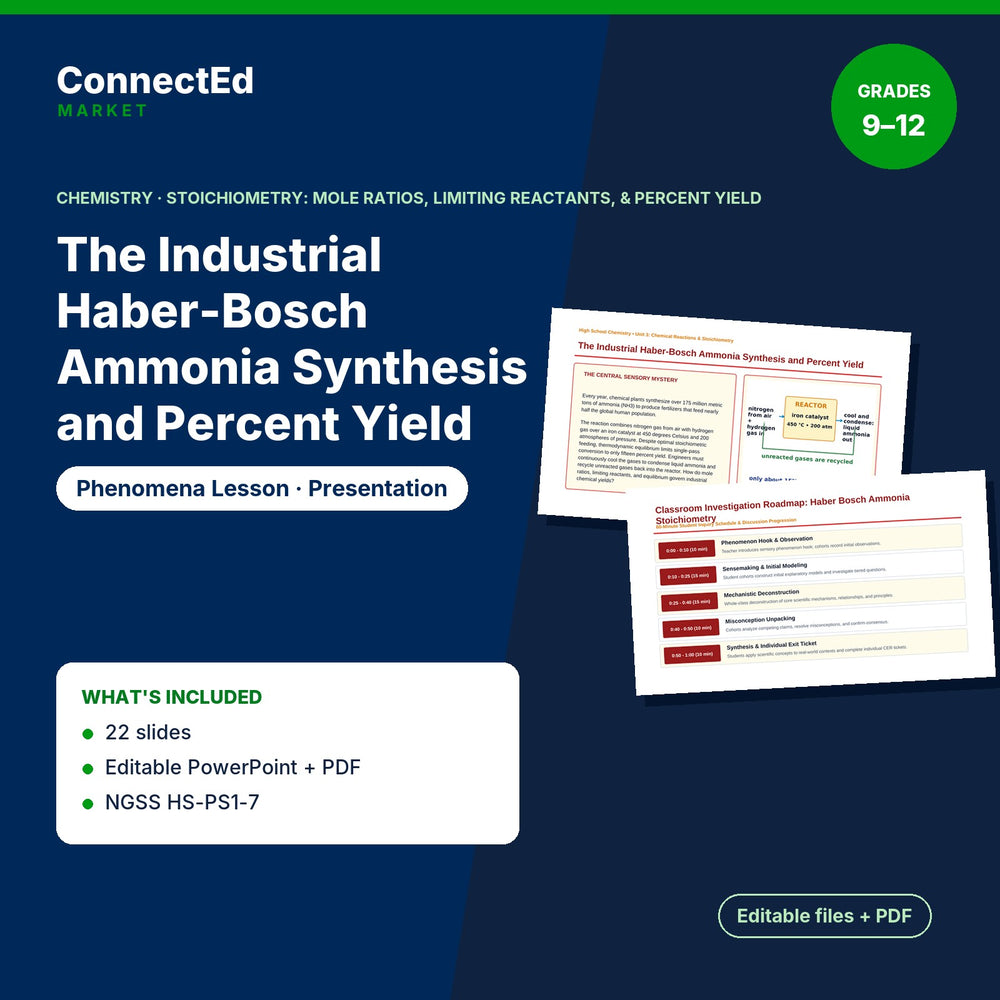
Stoichiometry: Mole Ratios, Limiting Reactants, & Percent Yield Phenomena-Based Lesson: The Industrial Haber-Bosch Ammonia Synthesis and Percent Yield Presentation
$3.50
Microsoft PowerPoint (editable) + PDF (ready to print) · Instant download
This is the student-facing slide presentation that introduces the phenomenon, walks the class through observations and driving questions, and frames the evidence students will use for the Phenomena-Based Lesson in the high school Chemistry (grades 9–12) chapter Stoichiometry: Mole Ratios, Limiting Reactants, & Percent Yield, built around the phenomenon The Industrial Haber-Bosch Ammonia Synthesis and Percent Yield. It is sold separately from the other two parts of the set.
Complete the set: Stoichiometry: Mole Ratios, Limiting Reactants, & Percent Yield Phenomena-Based Lesson: The Industrial Haber-Bosch Ammonia Synthesis and Percent Yield Teacher Discussion Guide; Stoichiometry: Mole Ratios, Limiting Reactants, & Percent Yield Phenomena-Based Lesson: The Industrial Haber-Bosch Ammonia Synthesis and Percent Yield Student Response Sheet. Scaffolded version: Stoichiometry: Mole Ratios, Limiting Reactants, & Percent Yield Scaffolded Phenomena-Based Lesson: The Industrial Haber-Bosch Ammonia Synthesis and Percent Yield Presentation.
Sections: Section 1: Three-dimensional Learning Alignment (ngss); NGSS Dimension; Aligned Three-dimensional Learning Goal; Section 2: Anchoring Phenomenon & Driving Inquiry; Section 3: Productive Science Talk Moves Matrix; Talk Move Category; Verbatim Facilitation Prompt & Goal; Section 5: Student Misconceptions & Scientific Corrections. Sample item: “How do mole ratios, limiting reactants, and equilibrium govern industrial chemical yields?”
What's inside: Student Slide Show (editable .pptx + PDF, 22 slides).
Aligned Standards: HS-PS1-7 — Use mathematical representations to support the claim that atoms, and therefore mass, are conserved during a chemical reaction.
Format: Microsoft PowerPoint (editable) + PDF (ready to print)
Classroom use: Project this presentation to introduce the phenomenon and guide the investigation, then move into discussion with the teacher guide.
Format note: If you do not open files with Microsoft Office, use the included PDF.