
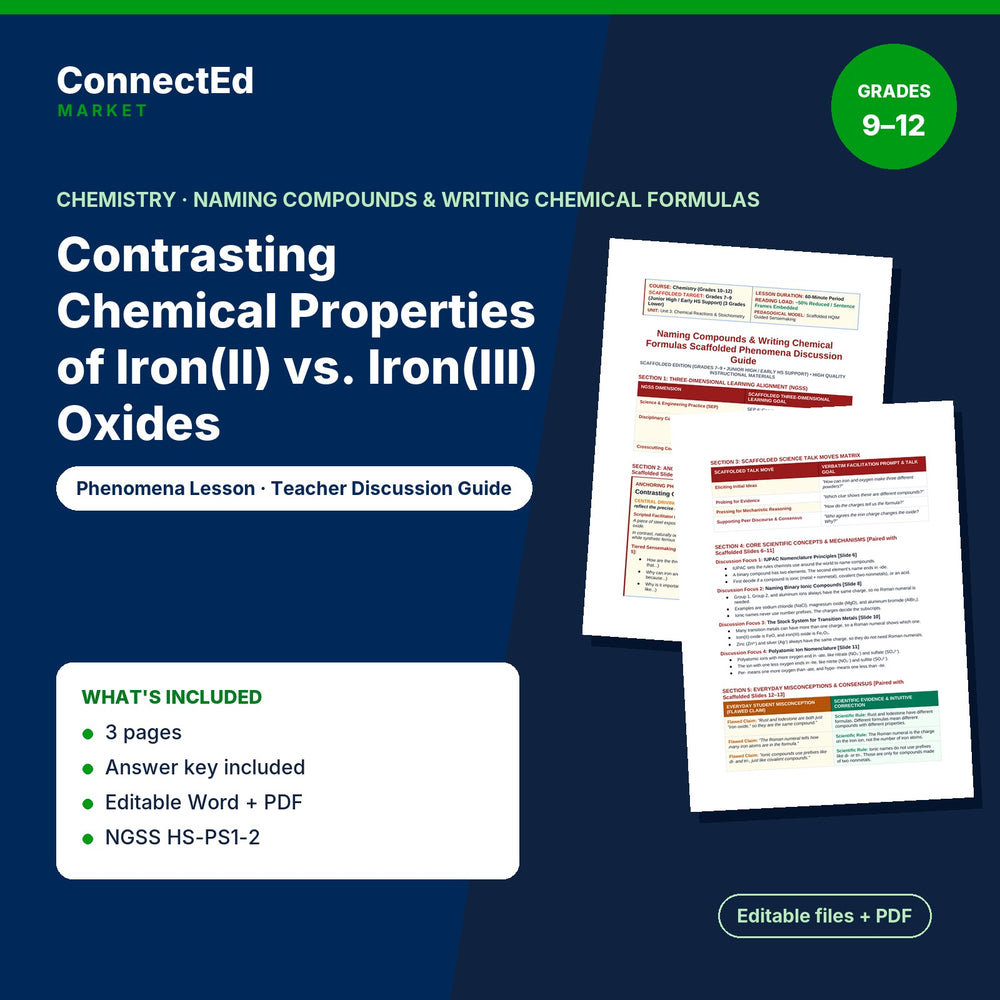
Naming Compounds & Writing Chemical Formulas Scaffolded Phenomena-Based Lesson: Contrasting Chemical Properties of Iron(II) vs. Iron(III) Oxides Teacher Discussion Guide
$3.50
Microsoft Word (editable) + PDF (ready to print) · Instant download
This is the teacher discussion guide, with lesson flow, facilitation questions, anticipated student ideas and model explanations for leading the class discussion for the Scaffolded Phenomena-Based Lesson in the high school Chemistry (grades 9–12) chapter Naming Compounds & Writing Chemical Formulas, built around the phenomenon Contrasting Chemical Properties of Iron(II) vs. Iron(III) Oxides. This scaffolded version adds sentence frames and extra supports for students who need them. It is sold separately from the other two parts of the set.
Complete the set: Naming Compounds & Writing Chemical Formulas Scaffolded Phenomena-Based Lesson: Contrasting Chemical Properties of Iron(II) vs. Iron(III) Oxides Presentation; Naming Compounds & Writing Chemical Formulas Scaffolded Phenomena-Based Lesson: Contrasting Chemical Properties of Iron(II) vs. Iron(III) Oxides Student Response Sheet. Original version: Naming Compounds & Writing Chemical Formulas Phenomena-Based Lesson: Contrasting Chemical Properties of Iron(II) vs. Iron(III) Oxides Teacher Discussion Guide.
Sections: Section 1: Three-dimensional Learning Alignment (ngss); NGSS Dimension; Scaffolded Three-dimensional Learning Goal; Section 3: Scaffolded Science Talk Moves Matrix; Scaffolded Talk Move; Verbatim Facilitation Prompt & Talk Goal; Everyday Student Misconception (flawed Claim); Scientific Evidence & Intuitive Correction. Sample item: “In iron(III) oxide, each iron ion has a charge of ____________.”
What's inside: SCAFFOLDED Teacher Discussion Guide (editable .docx + PDF, about 1,090 words, 3 pages); answer key / model answers for the teacher.
Aligned Standards: HS-PS1-2 — Construct and revise an explanation for the outcome of a simple chemical reaction based on the outermost electron states of atoms, trends in the periodic table, and knowledge of the patterns of chemical properties.
Format: Microsoft Word (editable) + PDF (ready to print)
Classroom use: Lead a 60-minute phenomenon-based lesson on the chapter with a timed discussion schedule. Use with the student response sheet and presentation.
Format note: If you do not open files with Microsoft Office, use the included PDF.