
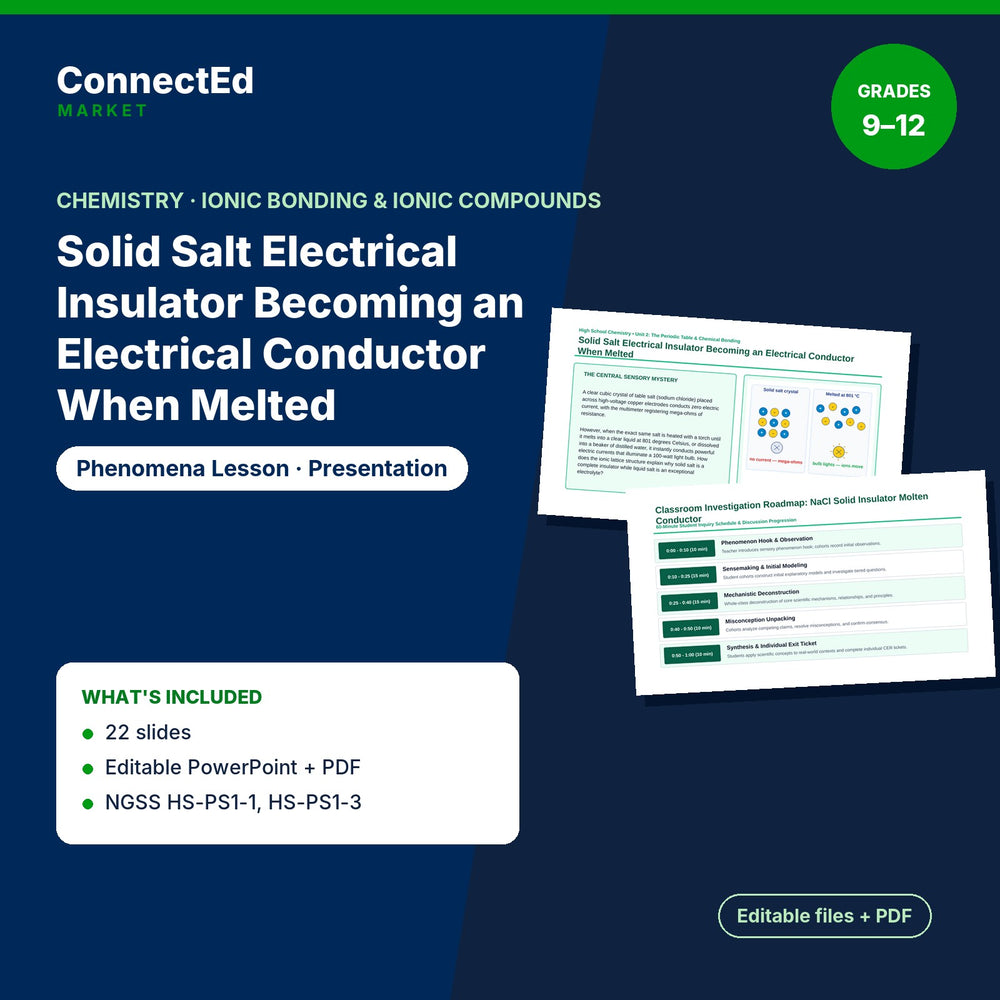
Ionic Bonding & Ionic Compounds Phenomena-Based Lesson: Solid Salt Electrical Insulator Becoming an Electrical Conductor When Melted Presentation
$3.50
Microsoft PowerPoint (editable) + PDF (ready to print) · Instant download
This is the student-facing slide presentation that introduces the phenomenon, walks the class through observations and driving questions, and frames the evidence students will use for the Phenomena-Based Lesson in the high school Chemistry (grades 9–12) chapter Ionic Bonding & Ionic Compounds, built around the phenomenon Solid Salt Electrical Insulator Becoming an Electrical Conductor When Melted. It is sold separately from the other two parts of the set.
Complete the set: Ionic Bonding & Ionic Compounds Phenomena-Based Lesson: Solid Salt Electrical Insulator Becoming an Electrical Conductor When Melted Teacher Discussion Guide; Ionic Bonding & Ionic Compounds Phenomena-Based Lesson: Solid Salt Electrical Insulator Becoming an Electrical Conductor When Melted Student Response Sheet. Scaffolded version: Ionic Bonding & Ionic Compounds Scaffolded Phenomena-Based Lesson: Solid Salt Electrical Insulator Becoming an Electrical Conductor When Melted Presentation.
Sections: Section 1: Three-dimensional Learning Alignment (ngss); NGSS Dimension; Aligned Three-dimensional Learning Goal; Section 2: Anchoring Phenomenon & Driving Inquiry; Section 3: Productive Science Talk Moves Matrix; Talk Move Category; Verbatim Facilitation Prompt & Goal; Section 5: Student Misconceptions & Scientific Corrections. Sample item: “How does the ionic lattice structure explain why solid salt is a complete insulator while liquid salt is an exceptional electrolyte?”
What's inside: Student Slide Show (editable .pptx + PDF, 22 slides).
Aligned Standards: HS-PS1-1 — Use the periodic table as a model to predict the relative properties of elements based on the patterns of electrons in the outermost energy level of atoms. HS-PS1-3 — Plan and conduct an investigation to gather evidence to compare the structure of substances at the bulk scale to infer the strength of electrical forces between particles. HS-PS2-6 — Communicate scientific and technical information about why the molecular-level structure is important in the functioning of designed materials.
Format: Microsoft PowerPoint (editable) + PDF (ready to print)
Classroom use: Project this presentation to introduce the phenomenon and guide the investigation, then move into discussion with the teacher guide.
Format note: If you do not open files with Microsoft Office, use the included PDF.