
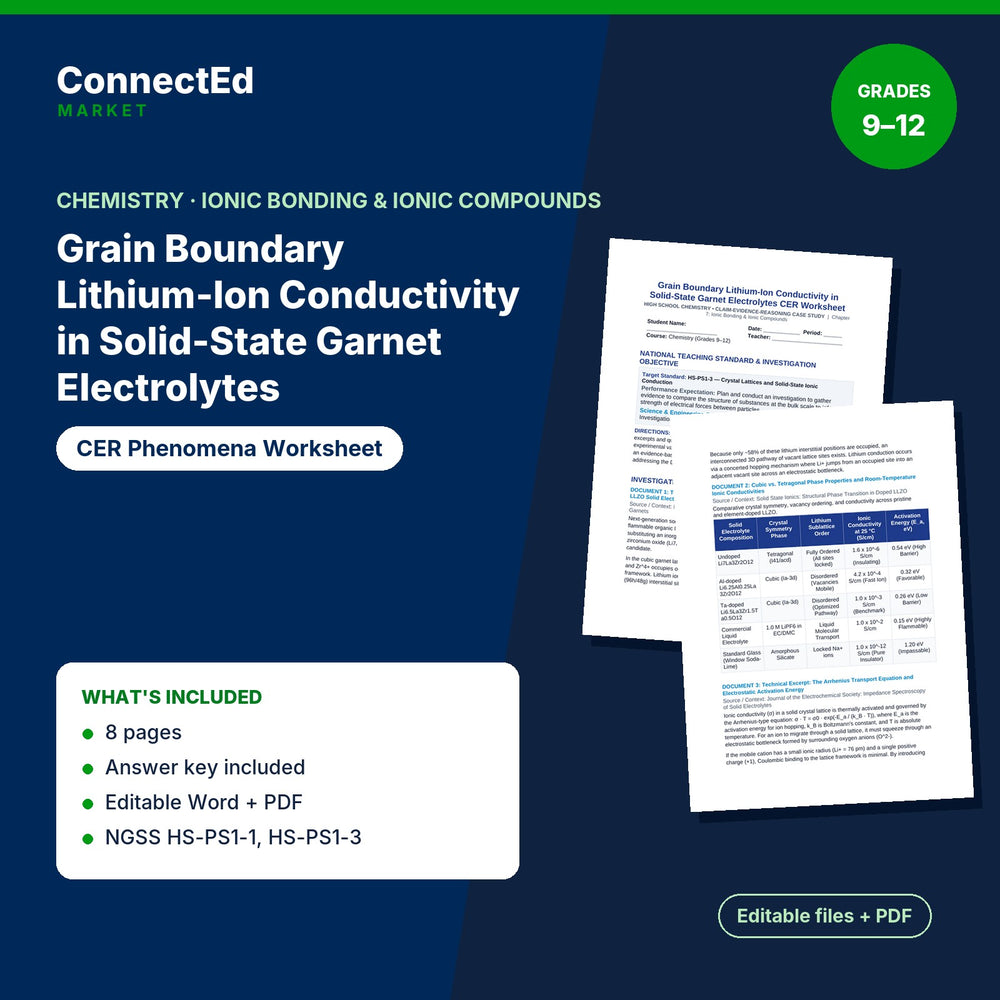
Grain Boundary Lithium-Ion Conductivity in Solid-State Garnet Electrolytes CER Phenomena Worksheet
$3.50
Microsoft Word (editable) + PDF (ready to print) · Instant download
Grain Boundary Lithium-Ion Conductivity in Solid-State Garnet Electrolytes CER Phenomena Worksheet is a Claim-Evidence-Reasoning phenomena worksheet for high school Chemistry (grades 9–12) on Grain Boundary Lithium-Ion Conductivity in Solid-State Garnet Electrolytes (chapter: Ionic Bonding & Ionic Compounds).
Pairs with: Ionic Bonding & Ionic Compounds Slide Show Presentation; Ionic Bonding & Ionic Compounds Guided Notes; Ionic Bonding & Ionic Compounds Lesson Quiz; Ionic Bonding & Ionic Compounds Vocabulary Words & Definitions.
Sections: National Teaching Standard & Investigation Objective; Investigation Evidence Dossier (documents 1–5); Document-based Scientific Writing Prompt (dbq); Student CER Writing Response Section; 4-point Analytic CER Scoring Rubric; 1. Exemplary Model Thesis / Claim:; 2. Designated Evidence Points From Documents:; 3. Comprehensive Scientific Reasoning:. Sample item: “Teacher: _______________________”
What's inside: Grain Boundary Lithium-Ion Conductivity in Solid-State Garnet Electrolytes CER Worksheet (editable .docx + PDF, about 1,712 words, 8 pages); answer key / model answers for the teacher.
Aligned Standards: HS-PS1-1 — Use the periodic table as a model to predict the relative properties of elements based on the patterns of electrons in the outermost energy level of atoms. HS-PS1-3 — Plan and conduct an investigation to gather evidence to compare the structure of substances at the bulk scale to infer the strength of electrical forces between particles. HS-PS2-6 — Communicate scientific and technical information about why the molecular-level structure is important in the functioning of designed materials.
Format: Microsoft Word (editable) + PDF (ready to print)
Classroom use: Students read the case, analyze the data, and write a CER argument; a model answer and scoring guide are included. Built for high school Chemistry, grades 9–12.
Format note: If you do not open files with Microsoft Office, use the included PDF.