
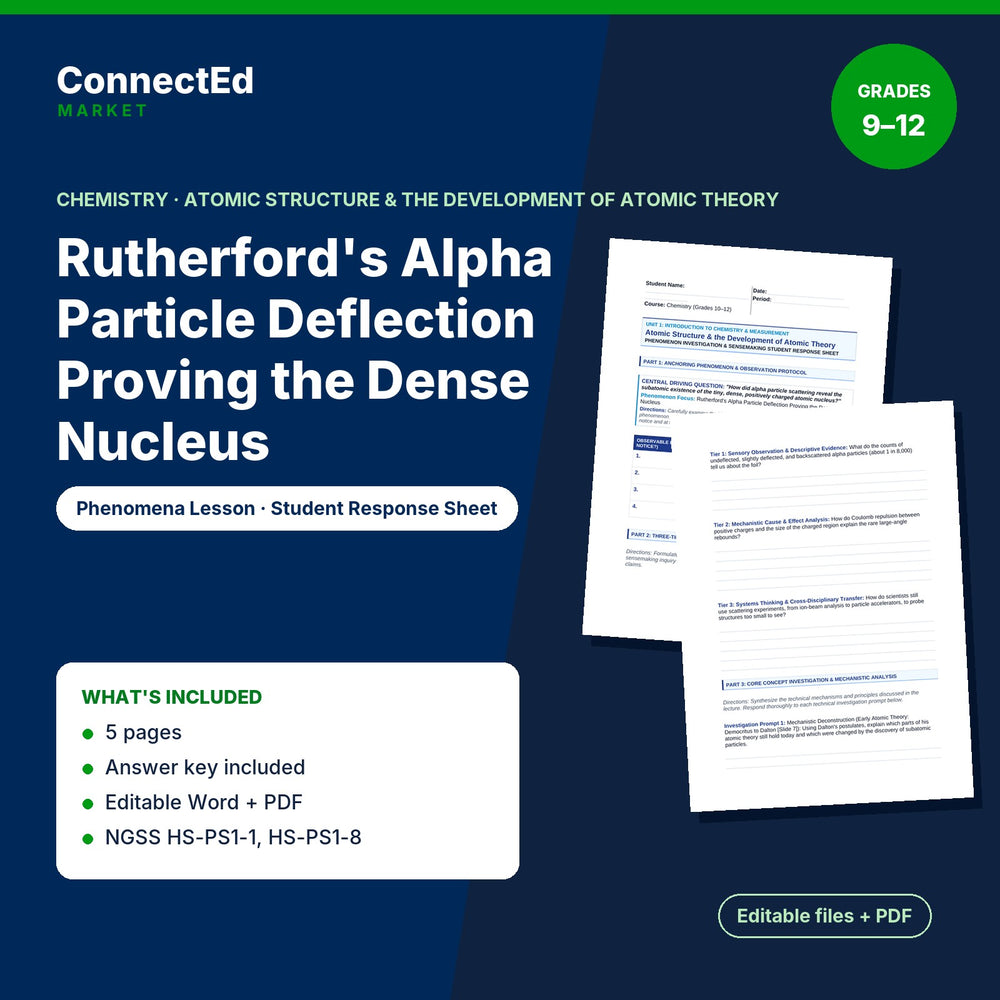
Atomic Structure & the Development of Atomic Theory Phenomena-Based Lesson: Rutherford's Alpha Particle Deflection Proving the Dense Nucleus Student Response Sheet
$3.50
Microsoft Word (editable) + PDF (ready to print) · Instant download
This is the student response sheet where students record observations, questions, evidence and their final claim–evidence–reasoning explanation for the Phenomena-Based Lesson in the high school Chemistry (grades 9–12) chapter Atomic Structure & the Development of Atomic Theory, built around the phenomenon Rutherford's Alpha Particle Deflection Proving the Dense Nucleus. It is sold separately from the other two parts of the set.
Complete the set: Atomic Structure & the Development of Atomic Theory Phenomena-Based Lesson: Rutherford's Alpha Particle Deflection Proving the Dense Nucleus Presentation; Atomic Structure & the Development of Atomic Theory Phenomena-Based Lesson: Rutherford's Alpha Particle Deflection Proving the Dense Nucleus Teacher Discussion Guide. Scaffolded version: Atomic Structure & the Development of Atomic Theory Scaffolded Phenomena-Based Lesson: Rutherford's Alpha Particle Deflection Proving the Dense Nucleus Student Response Sheet.
Sections: Section 1: Three-dimensional Learning Alignment (ngss); NGSS Dimension; Aligned Three-dimensional Learning Goal; Section 2: Anchoring Phenomenon & Driving Inquiry; Section 3: Productive Science Talk Moves Matrix; Talk Move Category; Verbatim Facilitation Prompt & Goal; Section 5: Student Misconceptions & Scientific Corrections. Sample item: “What atomic structure could explain such violent repulsion?”
What's inside: Student Response Sheet (editable .docx + PDF, about 640 words, 5 pages); answer key / model answers for the teacher.
Aligned Standards: HS-PS1-1 — Use the periodic table as a model to predict the relative properties of elements based on the patterns of electrons in the outermost energy level of atoms. HS-PS1-8 — Develop models to illustrate the changes in the composition of the nucleus of the atom and the energy released during the processes of fission, fusion, and radioactive decay.
Format: Microsoft Word (editable) + PDF (ready to print)
Classroom use: Hand students this response sheet to record observations and answer investigation prompts as they explore the phenomenon. Use with the teacher discussion guide.
Format note: If you do not open files with Microsoft Office, use the included PDF.