
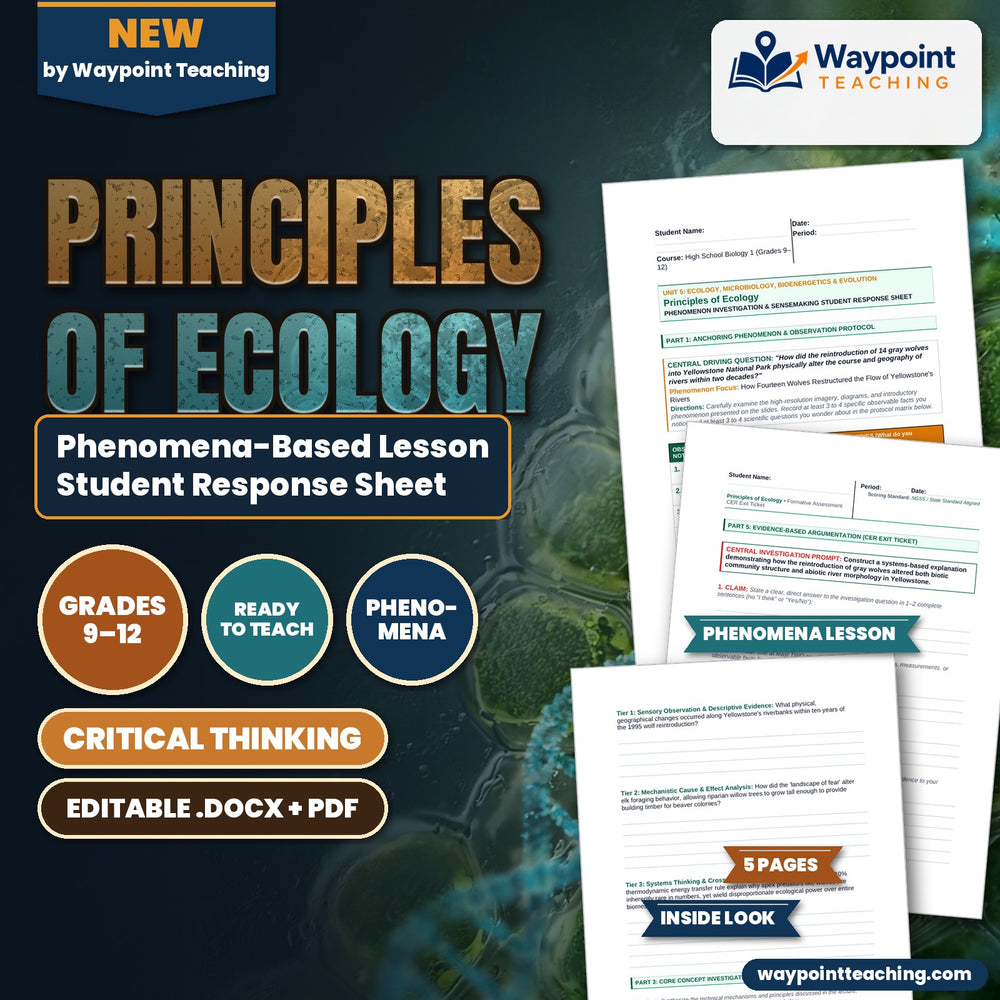
Principles of Ecology Phenomena-Based Lesson: Yellowstone Wolf Trophic Cascade Student Response Sheet
$3.50
Microsoft Word (editable) + PDF (ready to print) · Instant download
This is the student response sheet where students record observations, questions, evidence and their final claim–evidence–reasoning explanation for the Phenomena-Based Lesson in the high school Biology (grades 9–12) chapter Principles of Ecology, built around the phenomenon Yellowstone Wolf Trophic Cascade. It is sold separately from the other two parts of the set.
Complete the set: Principles of Ecology Phenomena-Based Lesson: Yellowstone Wolf Trophic Cascade Presentation; Principles of Ecology Phenomena-Based Lesson: Yellowstone Wolf Trophic Cascade Teacher Discussion Guide. Scaffolded version: Principles of Ecology Scaffolded Phenomena-Based Lesson: Yellowstone Wolf Trophic Cascade Student Response Sheet.
Sections: NGSS Dimension; Specific Performance Expectation & Dimensional Alignment; Slides; Segment; Focus Activity & Instructional Goal; Anchoring Driving Question (student Sensemaking):; Teacher Script (read Aloud To Introduce Phenomenon):; Talk Move Category. Sample item: “• Tier 1 (Observation): What physical, geographical changes occurred along Yellowstone's riverbanks within ten years of the 1995 wolf reintroduction?”
What's inside: Student Response Sheet (editable .docx + PDF, about 640 words, 5 pages); answer key / model answers for the teacher.
Aligned Standards: HS-LS2-1 — Use mathematical and/or computational representations to support explanations of factors that affect carrying capacity of ecosystems at different scales. HS-LS2-4 — Use mathematical representations to support claims for the cycling of matter and flow of energy among organisms in an ecosystem. HS-LS2-5 — Develop a model to illustrate the role of photosynthesis and cellular respiration in the cycling of carbon among the biosphere, atmosphere, hydrosphere, and geosphere.
Format: Microsoft Word (editable) + PDF (ready to print)
Classroom use: Hand students this response sheet to record observations and answer investigation prompts as they explore the phenomenon. Use with the teacher discussion guide.
Format note: If you do not open files with Microsoft Office, use the included PDF.