
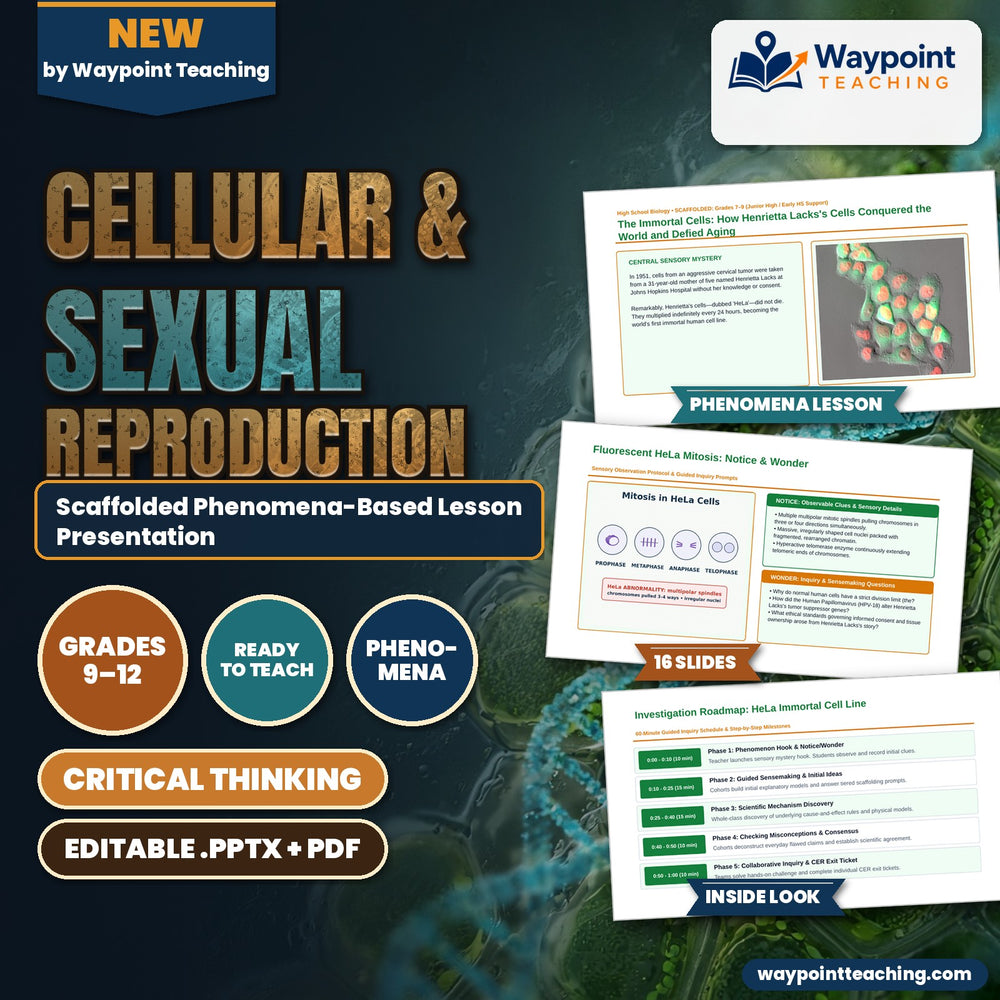
Cellular & Sexual Reproduction Scaffolded Phenomena-Based Lesson: HeLa Immortal Cell Line Presentation
$3.50
Microsoft PowerPoint (editable) + PDF (ready to print) · Instant download
This is the student-facing slide presentation that introduces the phenomenon, walks the class through observations and driving questions, and frames the evidence students will use for the Scaffolded Phenomena-Based Lesson in the high school Biology (grades 9–12) chapter Cellular & Sexual Reproduction, built around the phenomenon HeLa Immortal Cell Line. This scaffolded version adds sentence frames and extra supports for students who need them. It is sold separately from the other two parts of the set.
Complete the set: Cellular & Sexual Reproduction Scaffolded Phenomena-Based Lesson: HeLa Immortal Cell Line Teacher Discussion Guide; Cellular & Sexual Reproduction Scaffolded Phenomena-Based Lesson: HeLa Immortal Cell Line Student Response Sheet. Original version: Cellular & Sexual Reproduction Phenomena-Based Lesson: HeLa Immortal Cell Line Presentation.
Sections: Section 1: Three-dimensional Learning Alignment (ngss); NGSS Dimension; Scaffolded Three-dimensional Learning Goal; Section 3: Scaffolded Science Talk Moves Matrix; Scaffolded Talk Move; Verbatim Facilitation Prompt & Talk Goal; Everyday Student Misconception (flawed Claim); Scientific Evidence & Intuitive Correction. Sample item: “Normal somatic cells stop dividing after a certain number of cycles due to the Hayflick limit and the shortening of ____________.”
What's inside: SCAFFOLDED Student Slide Show (editable .pptx + PDF, 16 slides).
Aligned Standards: HS-LS1-4 — Use a model to illustrate the role of cellular division (mitosis) and differentiation in producing and maintaining complex organisms. HS-LS3-2 — Make and defend a claim based on evidence that inheritable genetic variations may result from (1) new genetic combinations through meiosis, (2) viable errors occurring during replication, and/or (3) mutations caused by environmental factors.
Format: Microsoft PowerPoint (editable) + PDF (ready to print)
Classroom use: Project this presentation to introduce the phenomenon and guide the investigation, then move into discussion with the teacher guide.
Format note: If you do not open files with Microsoft Office, use the included PDF.